Divinely Designed
Being changed into the image of Jesus
Being changed into the image of Jesus
Chapter 12
The Good Part of You -
You Are Not All Bad
(taken from the book "I Will Give You Rest" by Edward Kurath)
Frequently the cause of panic or anxiety is that we are afraid that we will
not measure up, or that we won't perform well enough, or that people
won't like us, or that we will be rejected. All of these relate to self-
judgment, as you learned in Chapter 9. Most people who suffer from
panic or anxiety are very hard on themselves, who judge themselves
greatly.
But you need to know that God does not see you as fundamentally
flawed or "bad." There is a part of you made in His image, and that part
of you still exists.
How Do You Feel About Yourself?
In the deep recesses of your being, how do you feel about yourself? I
am not talking about your accomplishments or the image you present
to the world, but how you feel deep down inside about yourself. For
instance,
many of these questions! Most assuredly, I was one of them.
Why would you feel this way? Is there nothing good that dwells in
you? Do you therefore need to "die to self?" After all, if you are "bad,"
this would explain why you feel like a worm.
Who Does God Say We Are?
God doesn’t agree with this derogatory view we may have of ourselves.
He is very clear about this. We are made in His image. You are. I am. It
is not just God in us that is good (though there are also places like
that). There are places in each of us that are purely "us," that are a part
of who we are, that are good. It is not just the Holy Spirit in us that is
good. When God said, "Let Us make man in Our image, according to
Our likeness" (Genesis 1:26), He did not say, "Let us make man to be
Us." We are separate creatures from Him. We are unique, but made in
His image. He is the pattern, but we are not Him, and He is not us. This
reality may be difficult for many to grasp, since there has been so much
teaching and preaching about how awful we are.
His Image Did Not Leave Us When
Adam And Eve Sinned
We are made in His image, and His image still dwells in us.
Theologians do not disagree regarding the fact that the image of God
dwells in us now. Where there is dispute is in regard to exactly what
constitutes the good part and what makes up the bad part. This dispute
is not likely to be resolved until Jesus comes again, because the
Scripture is not specific enough to tell us. Fortunately, we don’t need to
know in detail, because Jesus knows. The key point for us to realize is
that there is, here and now, a good part in each of us that is made in the
image of God!
Humility and Pride
Humility is a word that is frequently misused. Often humility is viewed
as recognizing what a worm I am, and how bad I am. "I am just an old
sinner." But humility really means to see myself the way God sees me.
When Jesus walked the earth He was humble, and yet He did not see
Himself as a worm. He did not see Himself as less than He was, nor
more than He was. He saw Himself as God the Father saw Him. He was
the only begotten Son and He was God, but He was not God the Father.
He did the will of the Father, not His own will (Matthew 26:39), because
God the Father was preeminent.
Humility is about truth. We are not to see ourselves as more than we
are, nor less than we are. Certainly, to see the truth about who we are in
comparison with who God is eliminates the possibility of prideful
boasting on our part. And yet, we are valuable because we are valuable
to God. At the same time, it is important that we find out who the
unique person is that God made us to be. To recognize our strengths
that He gave us as a gift is not prideful or wrong. Pride says that we did
something to earn it. Gifts by their very nature are not earned. They are
freely bestowed on us and are dependent on the giver, not the receiver.
So our strengths are free gifts bestowed on us, not things we
manufactured or earned by our own effort. Pride is to see myself as
more than I am. See Chapter 13, "The Bad Part Of You," for more on
pride.
Why Do We See Ourselves As
Worms?
Let me try to explain why so many of us feel badly about ourselves. For
some of us, we got constant messages from our parents that we
weren't worth much. Most importantly, our parents did not give us
messages that confirm the truth about our worth and our Treasure
Inside - we were victims of Type A Trauma. You may remember that
destroying our sense of being loveable and worthwhile is exactly what
Type A Trauma does. Type A Trauma is epidemic, and to some degree
it is probably universal.
Other Voices
Our siblings likely also gave us these same messages that did not
confirm our worth. Since they were raised in the same home, they also
suffered from Type A Trauma. In such a home there is competition for
the few crumbs of The Blessing which are available in the family. Each
child is trying to raise himself above the others, because if he can feel
superior to another child, he won’t feel so badly about himself at that
moment.
My Sister's Voice
I have an older sister who was also very wounded by Type A Trauma.
She was three years older than I, was a brilliant student, and was much
larger than I was. When I was growing up she would set traps for me
and play tricks on me to prove how much better she was, and she used
to beat me up and take my stuff. She used to make fun of me, and
called me “Shrimpo," because for much of our time growing up I only
came up to her shoulder. She did all of these things to make herself feel
a little better about herself, and what she said and did tore me down
even further. Her message just added to my already fragile self-image.
Our Culture's Voice
Our culture also tells us how unworthy we are. The other children are
doing the same thing as our siblings – competing for the crumbs of
blessing that are available. Our culture is obsessed with being Number
One, and competing to be Number One is seen as a wonderful thing!
Since by definition there can only be one Number One, that makes the
rest of us “losers." And those who are Number One in football are
probably not Number One in math, or art, or perhaps anything except
athletics. Thus they too are “losers." Therefore we are all losers, and
most of us feel that way about ourselves. It is a cultural sickness, and is
beautifully described as such by Alfie Kohn in his book, "No Contest".
Interestingly, when we compare ourselves with others, the areas where
we aren’t as good as the others are what impact us. Ironically, when we
become Number One at something, it seems hollow. The good feeling
of having achieved this victory is fleeting, and we still feel badly about
ourselves, because we focus on those areas where we fall short. God
is clear about this: But they, measuring themselves by themselves, and
comparing themselves among themselves, are not wise (2 Corinthians
10:12, KJV).
The Church's Voice
The Church has also tended to focus on the bad, giving us the
impression that there is nothing good that dwells in us. One scripture
presented in support of this is Romans 7:18:
It is in my flesh only that nothing good dwells, and these teachers
assume this refers to all of my natural being. But flesh (Greek sarx) is
another fuzzy Greek word. A detailed study reveals that my flesh, as
referred to in this scripture, is only a part of me, not all of my being.
Read Chapter 13, “The Bad Part Of You” for more on this. Jeremiah
Chapter 17 is often raised as proof that nothing good dwells in me.
Again, we are faced with a fuzzy word, the Hebrew word leb. There is
significant doubt that Jeremiah is referring to our entire inner man.
Further evidence we see of our own awfulness is that we are not living
up to the standards laid out for us by the church. Deep inside we
know we are falling short, and we feel that others are more successful
as Christians. I then think, "I am surely bad."
We Believe All These Voices
So we believed all these voices that surrounded our formative years.
Certainly, we think, they can’t all be wrong. From all of this we receive
our identity. We see ourselves as bad. But these voices are all wrong.
God sees us differently, and He is always right.
How Can We See Ourselves As God
Sees Us?
Many other teachers and authors have made lists of scriptures that tell
us how much God loves us, how valuable we are in His sight, how we
are His children, etc. They encourage us to meditate on this list, with
the implication that this exercise will convince us of who we really are.
While it is very important to know how God feels about us, meditating
on such a list (with our head) will not change how we feel about
ourselves.
Those of you that have tried this know how ineffective, frustrating, and
discouraging this is. In our head we know how God see us, but the
messages fail to make the journey to our heart. Our feelings don’t
change.
Then how can you change how you feel about yourself?
This Book Is Intended To Show You
How
That is what this book is intended to show you. If you read the book
and then apply it to your life, you will begin to see yourself as God sees
you, because the living God will show you. As you begin to feel His
love, the lies about how bad you are will be washed away.
Remember that judging yourself causes the wound which triggers the
Big Hurt and your anxiety, and this happens because this bitter root
judgment and hostility is so contrary to how God intended for you to
see yourself.
Summary
The purpose of this chapter has been to help you recognize some
misconceptions about how bad you are.
There is a part of you that was corrupted by The Fall, but this corrupted
part is not all of who you are. There is a part of you that is made in the
image of God. It is "you," it is good, and it still exists in you. God says
so in His Word. This is true whether you believe it or not.
A key part of your sanctification process (Inner Healing) is a complete
change of attitude towards who you are. There is buried treasure
inside you (as you read in Chapter 9). You need to come to know that
this is true before you can possibly be reconciled with yourself and
have harmony inside. After all, who would want to love and be best
friends with something evil?
For you to be sanctified (changed into the image of Jesus), all that is
"you" does not have to die. You are not rotten to the core. God
does not intend to annihilate you and replace you with Jesus.
Your Next Step
It would now be good for you to go to Chapter 2 and read the rest of the
posted chapters in numerical order.
Get The Whole Story
If what you have been reading makes sense to you, then to
actually take this journey out of anxiety and into peace, you
need the whole story.
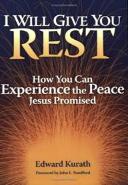
My book, "I Will Give You Rest" tells you everything you need
to know to experience the peace and rest Jesus promised.
He came to give us life here and now, not just in the life to
come.
Copyright 2003 Edward Kurath
The Good Part of You -
You Are Not All Bad
(taken from the book "I Will Give You Rest" by Edward Kurath)
Frequently the cause of panic or anxiety is that we are afraid that we will
not measure up, or that we won't perform well enough, or that people
won't like us, or that we will be rejected. All of these relate to self-
judgment, as you learned in Chapter 9. Most people who suffer from
panic or anxiety are very hard on themselves, who judge themselves
greatly.
But you need to know that God does not see you as fundamentally
flawed or "bad." There is a part of you made in His image, and that part
of you still exists.
How Do You Feel About Yourself?
In the deep recesses of your being, how do you feel about yourself? I
am not talking about your accomplishments or the image you present
to the world, but how you feel deep down inside about yourself. For
instance,
- • Do you tend to see others as better and more capable than
you?
• Do you always feel “less than” others?
• Do others seem to you to be more worthy of happiness and
prosperity?
• Do you have a "poverty mentality?" (A poverty mentality is
the expectation that you will never have more than the minimum
necessary to live on, and that you are not worthy of more).
• Are you too easily embarrassed?
• Are you petrified to speak in front of a group?
• Do you live in fear of being rejected?
• Do you often feel like a worm?
many of these questions! Most assuredly, I was one of them.
Why would you feel this way? Is there nothing good that dwells in
you? Do you therefore need to "die to self?" After all, if you are "bad,"
this would explain why you feel like a worm.
Who Does God Say We Are?
God doesn’t agree with this derogatory view we may have of ourselves.
He is very clear about this. We are made in His image. You are. I am. It
is not just God in us that is good (though there are also places like
that). There are places in each of us that are purely "us," that are a part
of who we are, that are good. It is not just the Holy Spirit in us that is
good. When God said, "Let Us make man in Our image, according to
Our likeness" (Genesis 1:26), He did not say, "Let us make man to be
Us." We are separate creatures from Him. We are unique, but made in
His image. He is the pattern, but we are not Him, and He is not us. This
reality may be difficult for many to grasp, since there has been so much
teaching and preaching about how awful we are.
His Image Did Not Leave Us When
Adam And Eve Sinned
We are made in His image, and His image still dwells in us.
Theologians do not disagree regarding the fact that the image of God
dwells in us now. Where there is dispute is in regard to exactly what
constitutes the good part and what makes up the bad part. This dispute
is not likely to be resolved until Jesus comes again, because the
Scripture is not specific enough to tell us. Fortunately, we don’t need to
know in detail, because Jesus knows. The key point for us to realize is
that there is, here and now, a good part in each of us that is made in the
image of God!
Humility and Pride
Humility is a word that is frequently misused. Often humility is viewed
as recognizing what a worm I am, and how bad I am. "I am just an old
sinner." But humility really means to see myself the way God sees me.
When Jesus walked the earth He was humble, and yet He did not see
Himself as a worm. He did not see Himself as less than He was, nor
more than He was. He saw Himself as God the Father saw Him. He was
the only begotten Son and He was God, but He was not God the Father.
He did the will of the Father, not His own will (Matthew 26:39), because
God the Father was preeminent.
Humility is about truth. We are not to see ourselves as more than we
are, nor less than we are. Certainly, to see the truth about who we are in
comparison with who God is eliminates the possibility of prideful
boasting on our part. And yet, we are valuable because we are valuable
to God. At the same time, it is important that we find out who the
unique person is that God made us to be. To recognize our strengths
that He gave us as a gift is not prideful or wrong. Pride says that we did
something to earn it. Gifts by their very nature are not earned. They are
freely bestowed on us and are dependent on the giver, not the receiver.
So our strengths are free gifts bestowed on us, not things we
manufactured or earned by our own effort. Pride is to see myself as
more than I am. See Chapter 13, "The Bad Part Of You," for more on
pride.
Why Do We See Ourselves As
Worms?
Let me try to explain why so many of us feel badly about ourselves. For
some of us, we got constant messages from our parents that we
weren't worth much. Most importantly, our parents did not give us
messages that confirm the truth about our worth and our Treasure
Inside - we were victims of Type A Trauma. You may remember that
destroying our sense of being loveable and worthwhile is exactly what
Type A Trauma does. Type A Trauma is epidemic, and to some degree
it is probably universal.
Other Voices
Our siblings likely also gave us these same messages that did not
confirm our worth. Since they were raised in the same home, they also
suffered from Type A Trauma. In such a home there is competition for
the few crumbs of The Blessing which are available in the family. Each
child is trying to raise himself above the others, because if he can feel
superior to another child, he won’t feel so badly about himself at that
moment.
My Sister's Voice
I have an older sister who was also very wounded by Type A Trauma.
She was three years older than I, was a brilliant student, and was much
larger than I was. When I was growing up she would set traps for me
and play tricks on me to prove how much better she was, and she used
to beat me up and take my stuff. She used to make fun of me, and
called me “Shrimpo," because for much of our time growing up I only
came up to her shoulder. She did all of these things to make herself feel
a little better about herself, and what she said and did tore me down
even further. Her message just added to my already fragile self-image.
Our Culture's Voice
Our culture also tells us how unworthy we are. The other children are
doing the same thing as our siblings – competing for the crumbs of
blessing that are available. Our culture is obsessed with being Number
One, and competing to be Number One is seen as a wonderful thing!
Since by definition there can only be one Number One, that makes the
rest of us “losers." And those who are Number One in football are
probably not Number One in math, or art, or perhaps anything except
athletics. Thus they too are “losers." Therefore we are all losers, and
most of us feel that way about ourselves. It is a cultural sickness, and is
beautifully described as such by Alfie Kohn in his book, "No Contest".
Interestingly, when we compare ourselves with others, the areas where
we aren’t as good as the others are what impact us. Ironically, when we
become Number One at something, it seems hollow. The good feeling
of having achieved this victory is fleeting, and we still feel badly about
ourselves, because we focus on those areas where we fall short. God
is clear about this: But they, measuring themselves by themselves, and
comparing themselves among themselves, are not wise (2 Corinthians
10:12, KJV).
The Church's Voice
The Church has also tended to focus on the bad, giving us the
impression that there is nothing good that dwells in us. One scripture
presented in support of this is Romans 7:18:
- For I know that in me (that is in my flesh) nothing good dwells.
It is in my flesh only that nothing good dwells, and these teachers
assume this refers to all of my natural being. But flesh (Greek sarx) is
another fuzzy Greek word. A detailed study reveals that my flesh, as
referred to in this scripture, is only a part of me, not all of my being.
Read Chapter 13, “The Bad Part Of You” for more on this. Jeremiah
Chapter 17 is often raised as proof that nothing good dwells in me.
Again, we are faced with a fuzzy word, the Hebrew word leb. There is
significant doubt that Jeremiah is referring to our entire inner man.
Further evidence we see of our own awfulness is that we are not living
up to the standards laid out for us by the church. Deep inside we
know we are falling short, and we feel that others are more successful
as Christians. I then think, "I am surely bad."
We Believe All These Voices
So we believed all these voices that surrounded our formative years.
Certainly, we think, they can’t all be wrong. From all of this we receive
our identity. We see ourselves as bad. But these voices are all wrong.
God sees us differently, and He is always right.
How Can We See Ourselves As God
Sees Us?
Many other teachers and authors have made lists of scriptures that tell
us how much God loves us, how valuable we are in His sight, how we
are His children, etc. They encourage us to meditate on this list, with
the implication that this exercise will convince us of who we really are.
While it is very important to know how God feels about us, meditating
on such a list (with our head) will not change how we feel about
ourselves.
Those of you that have tried this know how ineffective, frustrating, and
discouraging this is. In our head we know how God see us, but the
messages fail to make the journey to our heart. Our feelings don’t
change.
Then how can you change how you feel about yourself?
This Book Is Intended To Show You
How
That is what this book is intended to show you. If you read the book
and then apply it to your life, you will begin to see yourself as God sees
you, because the living God will show you. As you begin to feel His
love, the lies about how bad you are will be washed away.
Remember that judging yourself causes the wound which triggers the
Big Hurt and your anxiety, and this happens because this bitter root
judgment and hostility is so contrary to how God intended for you to
see yourself.
Summary
The purpose of this chapter has been to help you recognize some
misconceptions about how bad you are.
There is a part of you that was corrupted by The Fall, but this corrupted
part is not all of who you are. There is a part of you that is made in the
image of God. It is "you," it is good, and it still exists in you. God says
so in His Word. This is true whether you believe it or not.
A key part of your sanctification process (Inner Healing) is a complete
change of attitude towards who you are. There is buried treasure
inside you (as you read in Chapter 9). You need to come to know that
this is true before you can possibly be reconciled with yourself and
have harmony inside. After all, who would want to love and be best
friends with something evil?
For you to be sanctified (changed into the image of Jesus), all that is
"you" does not have to die. You are not rotten to the core. God
does not intend to annihilate you and replace you with Jesus.
Your Next Step
It would now be good for you to go to Chapter 2 and read the rest of the
posted chapters in numerical order.
Get The Whole Story
If what you have been reading makes sense to you, then to
actually take this journey out of anxiety and into peace, you
need the whole story.
My book, "I Will Give You Rest" tells you everything you need
to know to experience the peace and rest Jesus promised.
He came to give us life here and now, not just in the life to
come.
Copyright 2003 Edward Kurath

Chapter 2. |
 | |  | |  | |  | |  |
 | |  | |  | |  | |  |
 |
| |
 |
| |
 |
| |
 |
| |
 |
| |
 |
| |
 |
| |
 |
| |
 |
| |
 |
| |
 |

| book. |